Owning commercial real estate through private equity requires more than good deals. You need disciplined oversight that turns acquisitions into durable, income-producing assets and measurable investor returns. In this piece you will get a practical playbook for how specialized asset management drives value from underwriting to disposition, tailored to South Florida investors and private equity teams.
real estate asset management for private equity blends financial strategy, operations, and on-the-ground property leadership. Whether you manage single-family rental portfolios, multi-family complexes, or mixed-use value-add plays, the goal is the same, protect capital and grow net asset value.
Why private equity needs specialized asset management
Private equity investors operate on different timelines and return expectations than individual landlords. You are focused on IRR, multiple on invested capital, and a clear path to exit. That requires a team that can translate strategic investment theses into monthly, quarterly, and annual results.
What good asset management does for private equity:
- Aligns day-to-day operations with fund-level targets, from occupancy to NOI.
- Executes value-add plans, including targeted CapEx, repositioning, and lease-up strategies.
- Manages downside risk through active cost control, vendor oversight, and liquidity planning.
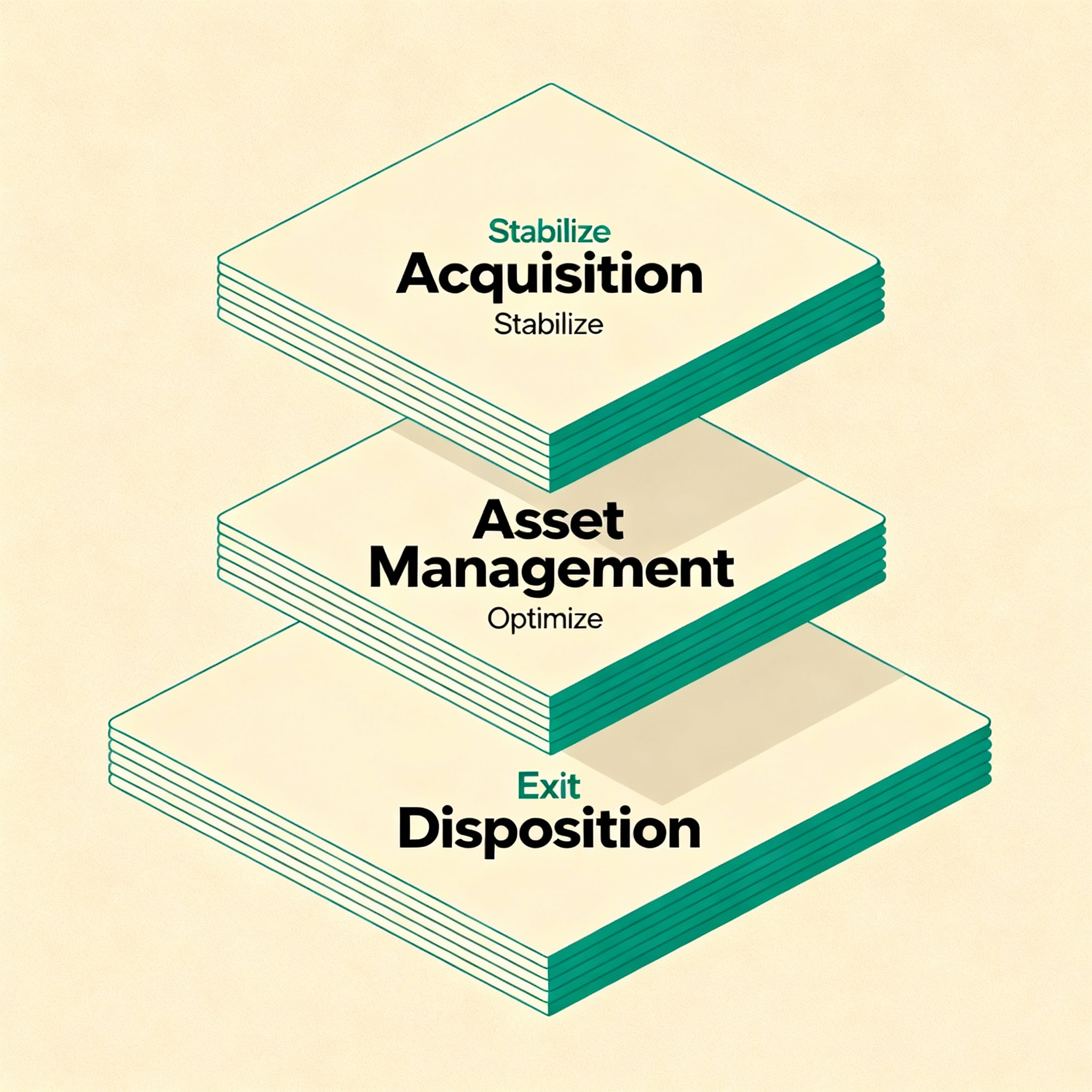
Core responsibilities of an asset manager for private equity
Financial oversight and performance tracking
- Build and maintain detailed budgets, cash flow models, and sensitivity scenarios.
- Monitor KPIs: occupancy, rent per unit, renewal rates, operating expense ratio, and EBITDA.
- Drive quarterly investor reporting and ad hoc deep dives when markets shift.
Value creation and value preservation
- Implement revenue optimization: smart leasing concessions, rent bumps at renewal, ancillary income streams.
- Sequence capital projects so you hit leasing milestones and avoid unnecessary downtime.
- Coordinate with property managers to ensure tenant satisfaction and reduce turnover.
Capital allocation and CapEx strategy
- Prioritize projects that compress time-to-stabilization and increase rent capture.
- Use staged CapEx with clear hurdle rates tied to expected yield improvements.
- Track project delivery, change orders, and total project ROI in real time.
Practical value-creation strategies that work
- Reposition units with cost-effective upgrades, focusing on kitchens, flooring, and smart HVAC controls to increase market rent.
- Add ancillary revenue: parking, storage, pet rent, and utility billing where allowed.
- Improve leasing velocity with localized marketing, digital tours, and referral incentives.
Local market nuance matters. In South Florida, seasonal demand from snowbirds, strong short-term rental markets in some submarkets, and climate resilience considerations shape the optimal mix of upgrades and leasing approaches.
Risk management, compliance, and ESG
- Maintain strict vendor selection and contract oversight to control service levels and costs.
- Ensure regulatory compliance at the municipal and state level, especially for rental licensing and short-term rental regulations.
- Incorporate climate risk and resilience planning into due diligence and insurance strategy for coastal assets.
Operational excellence and reporting
Operational execution separates plans from results. An effective asset management program delivers:
- Monthly financials with variance analysis and action plans.
- Quarterly investor decks tied to fund KPIs and market context.
- A communication cadence that keeps LPs comfortable while preserving manager flexibility.
Use technology platforms for lease administration, work order tracking, and financial consolidation to reduce manual errors and speed decision-making.
Local focus: South Florida and targeted markets
Private equity owners operating across West Palm Beach, Delray Beach, Fort Lauderdale, Port Saint Lucie, and Riviera Beach benefit from a manager who knows local demand drivers, seasonal flows, and neighborhood-level comps. For investors seeking hands-on management in these markets, our Asset Management page explains how we align local operations with fund goals: https://beacheswelcomeservice.com/asset-management/.
If you need coordinated property-level workstreams and hands-on onsite oversight, our Property Management services detail the operational capabilities and vendor network we use across Palm Beach and Broward Counties: https://beacheswelcomeservice.com/property-management/.
Market context: what investors are seeing now
Real estate markets are cyclical and uneven by sector. Global non-listed real estate assets under management have shifted in recent years as valuations and capital flows respond to interest rates and sector performance. For example, total global non-listed real estate AUM was reported at about €3.7 trillion in 2023, reflecting a market contraction from the pandemic peak. INREV Fund Manager Survey 2024.
Institutional target allocations to real estate have also trended around a mid-teens to low double-digit percentage of portfolios; recent reporting shows target allocations near 10.7 to 10.8 percent depending on the survey and year. These shifts matter when you plan fundraising, secondary market sales, or portfolio rebalancing. Financial Times coverage of institutional allocation trends.
How to structure asset management for private equity funds
- Establish clear operating covenants and delegated authority in the management agreement.
- Create aligned incentive structures, such as promote waterfalls, with transparent hurdle rates and calculation rules.
- Build a small, dedicated asset management team that can scale across assets and maintain consistent reporting standards.
Tools and technology to accelerate results
Adopt a combination of: a consolidated accounting platform, lease administration software, business intelligence dashboards, and a centralized work-order system. These tools reduce friction, enable real-time KPIs, and allow asset managers to focus on decisions that move the needle.
Frequently Asked Questions
What exactly does real estate asset management for private equity include?
Asset management focuses on financial and strategic oversight: budgeting, CapEx planning, performance optimization, investor reporting, and preparing assets for eventual sale or refinance. It does not usually handle daily maintenance, which is property management.
How is asset management different from property management?
Property management runs the daily operations, such as rent collection, tenant relations, and maintenance. Asset management sets the strategy to meet investor returns and coordinates multiple property managers across a portfolio when needed.
When should a private equity fund hire asset management versus do it in-house?
Hire outside specialists when you need local market expertise, quicker operational scaling, or when the fund lacks full-time real estate operating talent. Larger, repeat funds often build in-house teams, while smaller or geographically dispersed funds may outsource.
How do you measure success for asset management?
Success metrics include IRR and equity multiple for the fund, plus property-level KPIs like stabilized NOI, occupancy, rent per unit growth, and expense control. Regular variance analysis against budget is essential.
What are common mistakes private equity investors make with real estate assets?
Underfunding CapEx, failing to align manager incentives, ignoring localized leasing tactics, and weak vendor oversight. Also avoid assuming one-size-fits-all solutions across diverse markets like South Florida.
How do environmental risks affect asset management decisions in coastal markets?
Sea-level rise, flood risk, and insurance cost changes can affect valuations and operating costs. Asset managers should include resilience upgrades, adjust insurance strategies, and stress-test cash flows for extreme-weather scenarios.
Can Beaches Welcome Service coordinate both asset and property management for a private equity portfolio?
Yes. We provide aligned services from portfolio oversight to on-the-ground property operations, which reduces communication friction and shortens execution timelines. See our buy/sell and property management services for complementary capabilities: https://beacheswelcomeservice.com/real-estate/ and https://beacheswelcomeservice.com/property-management/.

Ready to protect and grow your portfolio
If you are a private equity investor or fund manager seeking disciplined asset oversight in South Florida, we can help you convert strategy into measurable performance. Reach out for a portfolio assessment and learn how our asset-first approach reduces risk and increases realizable value: https://beacheswelcomeservice.com/.
Conclusion
Strong real estate asset management for private equity turns underwriting into outcomes. It requires relentless focus on financial controls, staged capital, local market intelligence, operational excellence, and transparent reporting. If you want to preserve capital, accelerate stabilization, and position assets for a premium exit, prioritize a tailored asset management program that aligns incentives, tracks the right KPIs, and adapts to local market realities.