

Selling an investment property in South Florida brings opportunity and tax complexity, especially if you are an investor, accidental landlord, snowbird, home buyer, home seller, or private equity manager in West Palm Beach, Boynton Beach, Delray Beach, Fort Lauderdale, Port Saint Lucie, Fort Pierce, Lake Worth, or Riviera Beach. Selling investment property tax strategies can protect your gains and preserve cash flow when you sell, and Day 4 early stage business thinking reminds you to plan the sale as part of a longer cash management and growth roadmap. Here is a practical playbook for minimizing taxes, managing timing, and keeping more profit in your pocket.
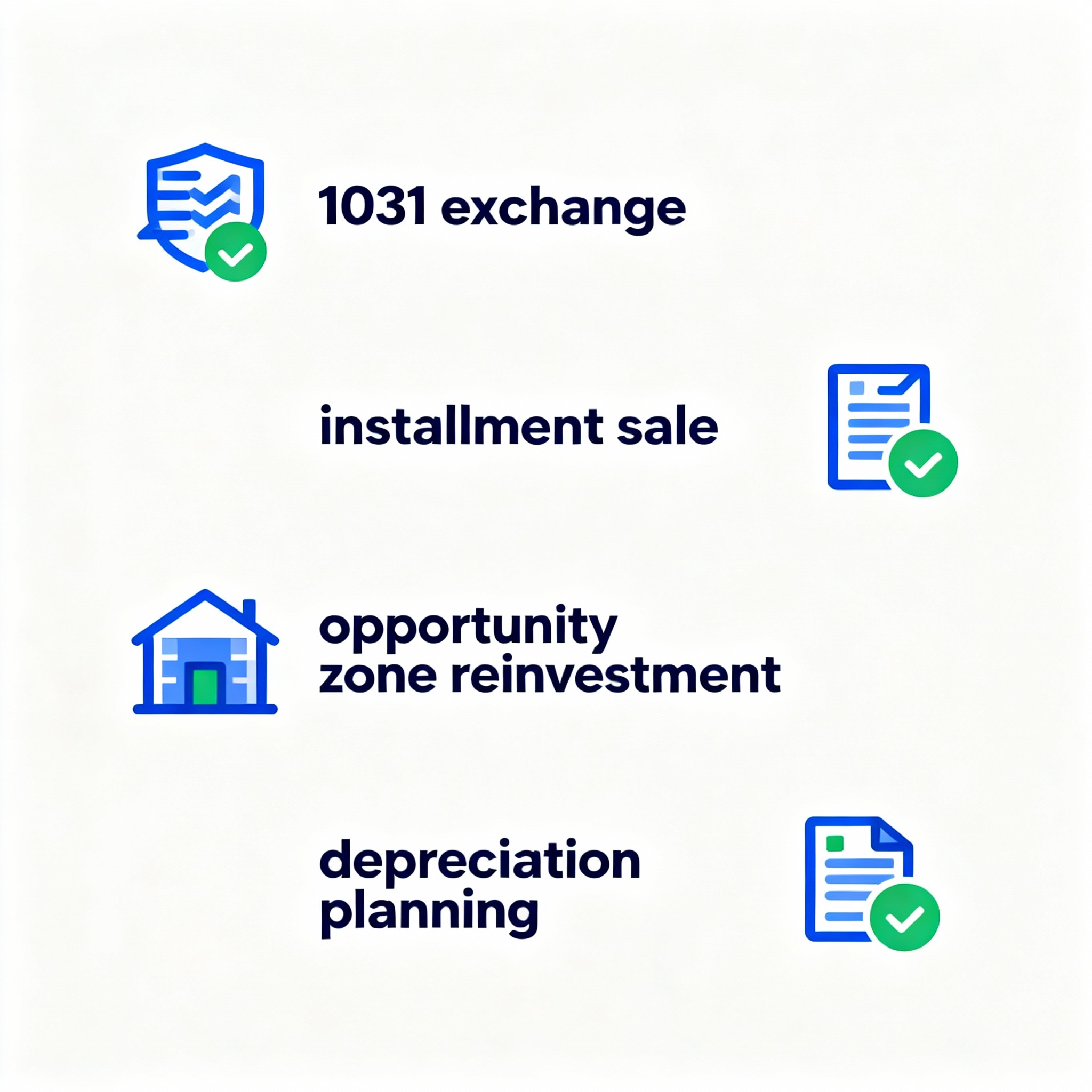
Selling Investment Property Tax Strategies: Key Options
Here are nine high-impact strategies that investors and sellers in South Florida commonly use. I walk through when each works best, pros and cons, and practical next steps you can take.
1. Like-Kind Exchange, When You Want to Defer Gains
- What it is, in short: exchange your property for another qualifying property to defer capital gains taxes. See IRS guidance for rules and timing. Like-Kind Exchanges, IRS
- Best for: investors who want to stay invested in real estate and avoid an immediate tax bill.
- Watch outs: strict 45 day identification rule and 180 day close window, and rules differ from 1031 for personal property.
2. Use an Installment Sale to Spread Income
- How it works: you accept payments over time so capital gains and tax burden are recognized across multiple years. Learn the mechanics on Investopedia. Installment Sale, Investopedia
- Best for: sellers who want predictable income and to avoid bumping into a higher tax bracket in one year.
- Tip: document the contract and consider interest rates and default risk.
3. Reinvest in Qualified Opportunity Zones for Tax Benefits
- Why it matters: rolling gains into a qualified opportunity fund can defer and potentially reduce gains if held long enough. Official IRS info explains the timelines and benefits. Qualified Opportunity Zones, IRS
- Best for: investors seeking long-term growth and partial tax exclusion while supporting community investment.
4. Time the Sale to Optimize Long Term Capital Gains
- Long term capital gains rates are generally lower than ordinary income rates if you held the property more than a year.
- If you can, delay closing until you qualify for long term treatment, or accelerate closing into a year when your taxable income will be lower.
- Small adjustments in timing can save thousands, especially for higher-value assets.
5. Manage Depreciation Recapture Carefully
- Depreciation lowers taxes while you own, but when you sell the IRS may recapture depreciation at higher rates.
- Work with your CPA to model depreciation recapture impact and explore strategies to offset it, including 1031 exchanges or cost segregation when acquiring other properties. For an accessible primer see Nolo on depreciation recapture. Depreciation Recapture, Nolo
6. Convert to Primary Residence, If Practical and Legal
- If you can and meet ownership and use tests, converting a rental to your primary residence for two years before selling may let you exclude up to a large amount of gain under the home sale exclusion.
- This is situational and requires a genuine change in use and proper documentation. Refer to IRS guidance on home sales for details. Sale of Your Home, IRS
7. Harvest Losses and Use Tax-Loss Strategies
- If you own other investments at a loss, coordinate the timing of sales so losses offset gains from your property sale.
- This is especially useful for accidental landlords or investors with a mixed portfolio.
8. Bundle Transactions With Your Overall Tax Plan
- Think beyond the single property. Combine moves like charitable gifts of appreciated real estate, gifting to family, or installment sales to manage taxable income across years.
- For private equity or portfolio oversight, use scenario modeling to project tax liability and cash needs.
9. Hire the Right Team Early
- You will need a CPA experienced in real estate taxation, a closing attorney familiar with state and local rules in Florida, and a broker who understands investor-grade sales.
- Here in South Florida, local expertise matters because municipal regulations, transient rental rules, and state incentives vary across West Palm Beach, Delray Beach, Fort Lauderdale, and neighboring markets.
Practical Steps to Start Today
- Run a simple tax scenario with your CPA: estimate capital gains, depreciation recapture, and net sale proceeds for different strategies.
- Decide if you plan to reinvest through a 1031 exchange or opportunity zone within the required timeline.
- Prepare property records now, including depreciation schedules and improvements, so your closing is clean and defensible.
Personal note: I once sat with an investor in Boynton Beach who planned to sell a fourplex to cash out for another venture. By shifting the closing date to the following tax year and choosing an installment approach, they reduced their immediate tax bill and maintained enough liquidity to fund the new project. Small planning, big difference.
Common Objections and Realities
- "I do not want the headache of a 1031." Fair point, it is more complex than a straight sale. But compare the tax savings to the administrative cost before ruling it out.
- "Opportunity zones are gimmicky." Not always. They can be powerful if you have long term plans and the right project type.
- "I need cash now." An installment sale may give both liquidity and tax smoothing.
FAQ
How much capital gains tax will I pay when I sell my rental property
It depends on your holding period, taxable income, depreciation taken, and filing status. Long term capital gains rates usually apply if you held the property more than one year, but depreciation recapture is taxed differently. Talk to a CPA to run your exact numbers.
Can I defer taxes by using a 1031 exchange in Florida
Yes, a properly executed like-kind exchange can defer federal capital gains tax and is commonly used in Florida. You must follow identification and closing timelines and work with a qualified intermediary.
What is depreciation recapture and how much will it cost me
Depreciation recapture taxes the gain attributable to prior depreciation deductions. It can increase your tax bill, so model the effect before you sell and consider strategies to mitigate it.
Are opportunity zones a good fit for small investors
They can be, but they typically favor investors who can commit capital for long periods and find qualified funds or projects. Evaluate fees, the fund manager, and the expected timeline before investing.
If I sell now, can I still minimize taxes through charitable strategies
Yes. Donating appreciated property or using charitable remainder trusts can provide tax benefits, but these are complex and require early planning with legal and tax advisors.
How do state taxes affect my sale in Florida
Florida has no state individual income tax, which can make net proceeds more favorable compared with other states. However, local transfer taxes, documentary stamps, and closing costs still apply.
Ready To Optimize Your Sale Today
If you want tailored help aligning tax strategy with long-term rental management, single-family and multi-family property management, vacation rental plans, or portfolio oversight, start with a conversation that maps your financial goals to tax options. For practical property management and sales services tied to investor needs in South Florida, visit Beaches Welcome Service to explore next steps and book an initial consultation.
Get expert local help at Beaches Welcome Service
Conclusion
Selling an investment property is a chance to crystallize years of effort into cash that can fund new deals, life goals, or portfolio rebalancing. With thoughtful planning, whether through a 1031 exchange, installment sale, opportunity zone investment, timing decisions, or depreciation management, you can preserve more of your profit. For investors, accidental landlords, snowbirds, home buyers, home sellers, and private equity operators across West Palm Beach, Boynton Beach, Delray Beach, Fort Lauderdale, Port Saint Lucie, Fort Pierce, Lake Worth, and Riviera Beach, the difference between a planned sale and an ad hoc sale can be tens of thousands of dollars, sometimes more. Start with clear numbers, the right team, and a plan, and you will sell smarter, not harder.

