

A sale can look successful on paper and still create an unwelcome tax bill if the planning happens after the contract is signed. For investors moving from an aging rental in Delray Beach, a duplex in Fort Lauderdale, or a small portfolio in Port Saint Lucie, a 1031 exchange South Florida strategy can keep more equity positioned for the next real estate investment.
We see the strongest results when owners treat the exchange as an acquisition plan, not simply a tax form attached to a sale. The process has strict federal rules, hard deadlines, and practical local challenges, including seasonal demand, insurance costs, property condition, and financing timelines.
What a 1031 Exchange Means for South Florida Investors
A 1031 exchange is a federal tax-deferment structure that may allow an investor to sell real property held for business or investment and acquire qualifying replacement real estate without recognizing all taxable gain at the time of sale. It is commonly called a like-kind exchange because the property being sold and the property being acquired must both be qualifying real property held for investment or business use.
The important word is deferment. A properly structured exchange does not erase tax. Instead, it generally carries the tax basis forward into the replacement asset. If that replacement property is later sold in a taxable sale, deferred gain may become taxable unless another qualifying strategy applies.
The IRS confirms that, since 2018, Section 1031 applies to real property rather than personal or intangible property. It also makes clear that a primary residence and property held mainly for resale do not qualify. Review the IRS guidance on like-kind exchanges with your CPA and real estate attorney before committing to a transaction.
Why South Florida owners use this strategy
An exchange can help an owner reposition capital without taking a full tax hit upfront. That may mean moving from a hands-on single-family rental in Lake Worth to a professionally managed apartment building, exchanging a concentrated Palm Beach County holding for several units, or shifting toward a different Florida market with a better operational fit.
For snowbirds and accidental landlords, the practical goal is often less day-to-day involvement. For experienced investors and private equity groups, it may be portfolio diversification, improved cash flow, a different tenant mix, or a more scalable asset-management model. Our guide to South Florida real estate investment strategies explores the operational questions that should sit beside tax planning.
The Key 1031 Exchange Rules
| Requirement | What It Means | Practical Impact |
|---|---|---|
| Investment use | Both properties must qualify | Personal homes do not qualify |
| Qualified intermediary | Holds exchange funds | Set this up before closing |
| 45-day identification | Name replacement options in writing | Build a backup property list |
| 180-day acquisition | Complete the replacement purchase | Coordinate lender and closing teams |
| Equal or greater reinvestment | Helps defer all gain | Cash received can create taxable boot |
Investment property must be exchanged for investment property
Real estate is broadly considered like-kind for these purposes. A residential rental may be exchanged for commercial property, raw land, a multifamily building, or another qualifying rental property, provided both sides of the transaction are held for investment or business use.
A home used exclusively as your personal residence is different. Converting a former residence or vacation property into qualifying investment property involves facts and circumstances that deserve individualized tax advice. Do not assume a property qualifies simply because it was rented for a short period.
The qualified intermediary cannot be an afterthought
In a deferred exchange, you generally cannot receive or control the sale proceeds. A qualified intermediary, often called a QI, coordinates the exchange documents and holds funds under the exchange arrangement. If the seller receives the money directly, the exchange can fail even if a replacement property is purchased later.
Engage the QI before the sale closing. Your attorney, CPA, title team, lender, broker, and intermediary should understand the intended structure early enough to coordinate documentation and settlement instructions.
The 45-day and 180-day deadlines are not flexible planning targets
The most important numbers are 45 and 180. Under the IRS instructions for Form 8824, replacement property must be identified in writing within 45 days after transferring the relinquished property, and it must be acquired within 180 days, or by the earlier applicable federal filing deadline.
That timeline moves quickly in South Florida, where inspections, condominium documents, insurance quotes, lender underwriting, and association approvals can affect a closing. We recommend identifying viable alternatives before listing the property you intend to sell, rather than hoping an ideal replacement appears after the clock begins.
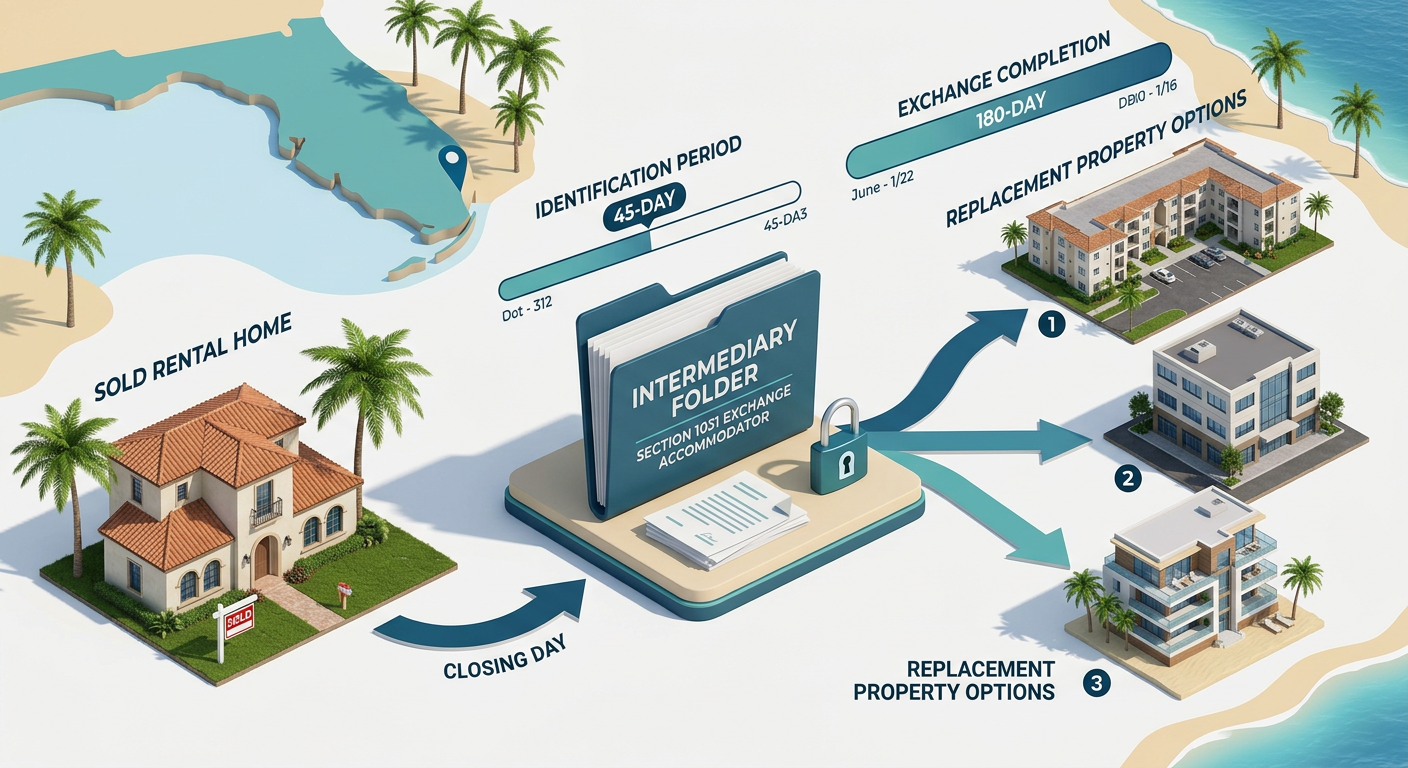
How a Typical Exchange Works
A standard deferred exchange usually follows a structured sequence:
- Clarify investment goals. Decide whether the replacement asset should improve cash flow, reduce management intensity, add units, enter a new submarket, or rebalance risk.
- Assemble the advisory team. Confirm the plan with a tax professional, attorney, real estate agent, lender, title company, and qualified intermediary.
- Sell the relinquished property. The QI documentation must be in place before the closing, and proceeds move to the exchange arrangement rather than directly to the seller.
- Identify replacement properties. Within 45 days, submit a written, properly described list to the appropriate party under the exchange rules.
- Complete the acquisition. Close on one or more properly identified replacement properties within the 180-day exchange period.
- Report the transaction. Like-kind exchanges are generally reported on IRS Form 8824 as part of the federal tax filing.
This structure sounds orderly, but execution is where deals succeed or fail. A lender delay, an inspection issue, a missing insurance quote, or a seller unwilling to extend can put the entire plan under pressure.
Local Decisions That Can Strengthen the Replacement Purchase
A 1031 exchange should improve the portfolio, not merely postpone a tax obligation. Before selecting a replacement property in West Palm Beach, Boynton Beach, Riviera Beach, Fort Pierce, or elsewhere in the region, we encourage investors to evaluate the asset through both a tax and operations lens.
Underwrite income beyond the advertised rent
Look at realistic rent, vacancy, maintenance reserves, property taxes, insurance, capital needs, leasing costs, and management fees. A property with a higher headline rent can still underperform if deferred maintenance or association restrictions create ongoing friction.
This is especially relevant when trading a single-family home for multifamily property. Our multifamily asset management guide explains why capital planning, reporting, and operational discipline matter as a portfolio becomes more complex.
Match the asset with your ownership capacity
A snowbird who wants stable income and fewer calls may favor a newer long-term rental with dependable management. An investor focused on value creation may accept renovation risk, but should confirm construction budgets, permitting exposure, and insurance requirements before using precious exchange time on the deal.
Private equity and larger ownership groups should also establish decision authority before the sale. The 45-day identification period is a poor time to begin debating markets, target yields, debt terms, or asset class.
Keep sufficient liquidity outside the exchange
Reinvesting every available dollar may help maximize tax deferment, but it should not leave the ownership group without reserves. Plan for closing costs, lender requirements, repairs, insurance, operating capital, and unexpected post-closing expenses.
A replacement property needs to work after the closing table, not just on the settlement statement. For a broader framework, see our perspective on real estate asset management for portfolios.

Common Mistakes to Avoid
The biggest mistake is waiting until after the sale closes to decide whether an exchange makes sense. By then, direct receipt of funds can eliminate the intended tax treatment.
Other common problems include:
- Treating a personal residence as an exchange property without qualified tax guidance.
- Missing the written 45-day identification deadline.
- Naming only one replacement property with no viable backup.
- Underestimating financing, inspections, or association approval timelines.
- Taking cash out of the exchange without understanding potential taxable boot.
- Buying a replacement asset that is poorly aligned with the investor's long-term plan.
The IRS notes that receiving cash or other non-like-kind value can require gain recognition to that extent. That is why the acquisition price, debt structure, closing costs, and cash movement should be reviewed together, not in separate conversations.
Frequently Asked Questions
Can we exchange a South Florida rental for property in another state?
Generally, yes. Qualifying U.S. investment real estate can be like-kind to other qualifying U.S. investment real estate. However, U.S. property and foreign property are not like-kind to each other under the federal rules.
Can we use a 1031 exchange for a primary residence?
Generally, no. A primary residence is not property held for investment or business use. Some owners have mixed-use or converted properties, but those situations require individualized advice from a tax professional and attorney.
Do we have to buy a property worth more than the one we sell?
Not in every circumstance, but acquiring equal or greater value and reinvesting net exchange proceeds is commonly part of a plan to defer the full gain. A lower-value purchase or cash received may create taxable boot.
What happens if we miss the 45-day deadline?
The exchange will generally not qualify as a deferred 1031 exchange. The identification period is a strict calendar deadline, which is why we recommend preparing replacement options before the relinquished property closes.
Can a vacation rental qualify for a 1031 exchange?
It may, if the property is genuinely held for investment or business use and the facts support that position. Personal use, rental activity, ownership intent, and documentation matter, so obtain professional advice before relying on an exchange.
Is a 1031 exchange only for large investors?
No. It can be relevant for owners of a single rental home as well as multifamily operators and institutional portfolios. The decision should depend on projected tax exposure, transaction costs, financing, investment goals, and the quality of the replacement opportunity.
Build the Exchange Around the Next Asset
A well-planned exchange gives investors a chance to reposition equity, improve portfolio fit, and defer current tax exposure within a carefully structured federal framework. The deadlines are unforgiving, so the strongest approach is to prepare the replacement plan, advisory team, and financing path before the sale becomes urgent.
For South Florida owners, the best replacement property is not automatically the newest building or the highest advertised rent. It is the asset that fits your ownership goals, risk tolerance, operating capacity, and long-term portfolio strategy.
Plan Your Next South Florida Investment Move
We help investors, accidental landlords, snowbirds, and portfolio owners evaluate purchases, sales, and management needs across South Florida. Visit Beaches Welcome Service to discuss a property transition and build a practical plan for the asset you want to own next.
This article is educational and is not tax, legal, or investment advice. Consult qualified tax and legal professionals about your specific transaction.

